




Trezor-vs-Ledger
15views

Table of Contents
Cryptocurrency investors are not questioning the necessity of having a hardware wallet anymore, but are questioning what a good one is to purchase. As threats such as phishing, malware, and exchange hacks increase, security has become an important component of the management of digital assets. This comparison measures Trezor and Ledger based on five significant aspects to establish which wallet is the smarter purchase.
Security Features and Technology.
The issue of security is at the core of the selection of the appropriate crypto wallet to keep in long term storage. Trezor has open source firmware and Ledger has a secure element chip. Protecting the keys used by the two is through different ways but is meant to prevent unauthorised access.
Trezor enables transparency so anyone can review the firmware and propose solutions to vulnerabilities. It does not use a secure chip in particular models but introduces PINs and passphrases. The other distinctive feature that reinforces recovery protection is Shamir Backup.
Ledger keeps the private keys in a certified chip, which is not vulnerable to physical and remote attacks. The keys are not made known to the outside of the chip. Regular firmware updates are also helpful in fixing weaknesses and increasing the number of coins supported safely.
Cryptocurrency Support
Coin support is critical in the management of a diverse or growing crypto portfolio. Ledger possesses over 5,500 assets, whereas Trezor possesses a little bit more than 1,500 assets. The information is varying, but the two wallets facilitate major cryptocurrencies like Bitcoin and Ethereum.
The native coins are supported in Ledger with the help of its Ledger Live app, and external applications, such as Metamask, are often required to access specific tokens. This inequality has convenience implications especially to users with a large number of assets.
Trezor is compatible with most ERC-20 tokens as well as major networks, but is not compatible with a wider range of altcoins. Ledger offers an increase in built-in support of DeFi and NFT ecosystems. This will make Ledger more attractive to active or skilled crypto users.
Hardware and Software Integration.
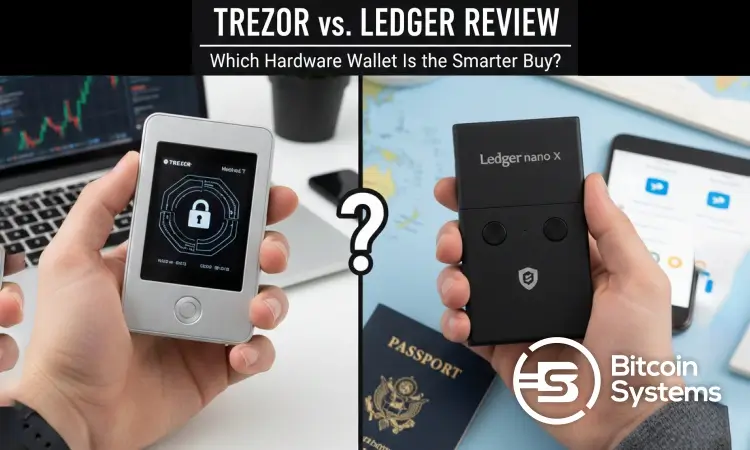
The characteristics of the wallets define the level of interaction of the users with the device and the daily management of their possessions. Trezor Model T provides a colored touchscreen. The Ledger Nano models have a button and a smaller screen as inputs.
Ledger Nano X features Bluetooth, and thus, it can also be easily used in mobile mode and is not connected by cables. Trezor does not support wireless connection and must be connected to a USB. This may restrict the mobility of users with funds on mobile handsets.
Ledger Live is an app that tracks a portfolio, stakes and swaps assets on a single screen. Trezor Suite pays more attention to the transfer of money and its safe receipt. The ecosystem of Ledger is more comprehensive to users who use in app transactions.
User friendliness and Setup Experience.
The two brands are both easy to use, though there is a slight variation in the learning curve. Trezor devices are easy to set up with user-friendly interfaces that are easy for a beginner. The Model T is a touchscreen, which enhances navigation.
A ledger requires users to go through a few additional steps to set it up. But when fully developed, the wallet offers more developed capabilities. New users might require time, but have wider capabilities in the long run.
Trezor Suite is an app with a sparse design and powerful privacy settings. The tools, graphs, and direct staking are supported in Ledger Live. The decision will be based on the fact that simplicity or full-feature access will be more important to the user.
Pricing and Overall Value
Pricing of the wallets differs based on model, features and usage. Trezor begins at approximately 49 euros, whereas the entry model of Ledger costs approximately 79 euros. Trezor is competent when it comes to the simplistic consumers.
The quality models are high and expensive.The price of Ledger Stax is approximately 399 dollars and Trezor Model T is approximately 169 dollars. These features, including Bluetooth, NFT, and user staking, should be matched with the price.
Trezor provides well-grounded security and the necessary features at a reduced cost. Ledger is supported with more features and is wider, which merits a higher price. Value is a factor based on your preference for simplicity or high capabilities.
Conclusion and Final Comparison.
Both wallets provide safe cold storage and are popular in the crypto community. They are constructed to cater to various users with different priorities. So, there is no wallet that would be appropriate under all circumstances.
Trezor is best suited to people who require transparency, less expensive and direct crypto management. It is very secure using open-source and can recover through various means. The simple models are easy to use and do not interfere with safety.
Ledger is distinguished by the users who require more sophisticated features, greater support for coins, and the opportunity to use it on the move. It is complete with the secure chip, Bluetooth and native app ecosystem. Overall, the brighter is brighter in dealing with a broad portfolio or requiring more built-in control.
add a comment


How to Manage Risk in Crypto Trading with Proper Position Sizing
Numerous traders come to the crypto market with a lot of hope and little plan. Even experienced analysis does not...


Understanding Crypto Rug Pulls: Avoiding the Next Big Scam
Each day new crypto currency projects are launched and attract investors with prospects, innovative and high returns. Most of these...
