




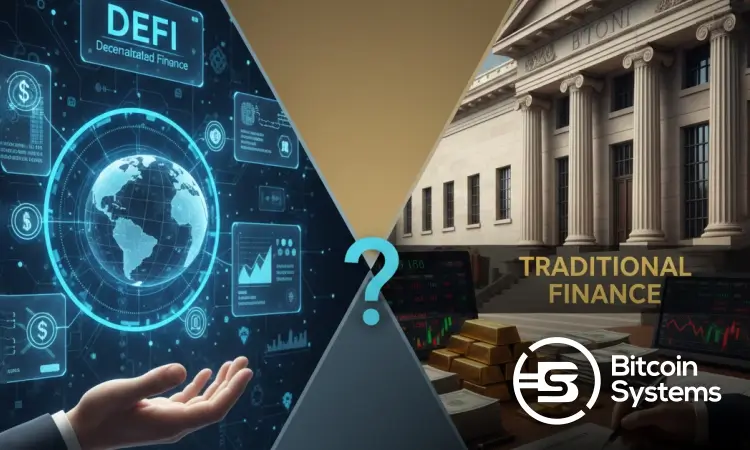
DeFi vs. Traditional Finance_ Where Should You Put Your Money_
125views

Table of Contents
In the ever accelerating world of finance today, investors are looking to understand where to allocate their funds for optimal returns. There seems to be a competition between two systems, namely DeFi and TradFi. Even though both have distinct ways for maximizing investment returns, they have distinct structures, regulations, as well as levels of associated risks.
Overview of Decentralized Finance (DeFi)
DeFi is a finance system based on the blockchain network, which enables customers to buy, lend, and borrow funds directly without having to go through banks. It provides finance services for customers on its own, using smart contracts, thereby reducing fees as well as the time taken. Customers from any point across the globe can make use of the DeFi systems without having to consider their credit scores.
The decentralized model gives complete control over funds and transactions to the users. Most of it works on open-source code, which provides transparency and speed as significant advantages. Aave, Uniswap, and Compound are among the popular ones, leading the space by offering fast, direct financial tools.
DeFi isn’t anchored to banks, governments, or borders because it runs on blockchain networks. It’s a whole new way to earn, invest, and grow wealth. The freedom it offers comes with other challenges, though: in terms of security and regulation.
Overview of Traditional Finance
Traditional finance includes banks, insurance companies, stock markets, and regulatory institutions that manage and protect money. It offers services through licensed professionals, physical branches, and online platforms with legal backing. Its activities are subject to government rules primarily devised to protect consumers and promote stability in the markets.
The institution of this deal includes JPMorgan Chase, Goldman Sachs, and regional banks. Regulatory bodies such as the SEC and Federal Reserve set the standards and ensure observance through monitoring of operations. It is a structure with strong consumer protection, offering substantial legal support in cases of disputes or fraud.
While TradFi offers trusted services and broad adoption, access for many users is significantly limited. Requirements of paperwork, high fees, and branch access might lock millions of people all over the world. The system is secure, but often neither inclusive nor fast.
Differences Between DeFi and Traditional Finance
Control, transparency, and access are what divide these financial systems. Each serves the user differently and is based on structure and user responsibility. Here is how they compare:
Control of Funds:
- DeFi: users manage their funds without any kind of intermediaries.
- TradFi: Your money is held and managed by banks/institutions.
Transparency:
- DeFi: It is public, transparent, and verifiable on the blockchain.
- TradFi: The details of a transaction are not exposed to the public because they remain within internal systems.
Accessibility:
- DeFi: Accessible to any person with access to the internet and in possession of a digital wallet.
- TradFi: Often bound by location, credit score, or paperwork.
Speed and Cost:
- DeFi: Transactions are usually faster and cheaper.
- Traditional Finance: Slower services due to mediators and higher operational costs.
These dissimilarities dictate how users relate to money and make investor decisions in an immediate market.
Benefits and Risks
Both have advantages and disadvantages . It is very essential for investors to be aware of both. A comparison of both has been provided below.
Benefits of DeFi
- Global Inclusion: Reaching the unbanked as well as underserved markets.
- Low Fees: It does not involve any middlemen, hence it has lower fees.
- User Control :Self-sovereignty of the money, without third-party custody.
What are some DeFi risks?
- Security Issues because some bugs in smart contracts have caused huge losses.
- No Legal Support: Lack of any legal assistance in retrieving stolen or missing funds.
- Volatility: The sudden changes in the values of assets may lead to substantial losses.
Benefits of Traditional Finance
- Regulation: It shields customers from harm below the regulation.
- Stability: Institutions must assure trust and reliability.
- Insurance: The deposits are insured. In the event of fraud, the deposits can be restored. Catch phrase
Risks of Traditional Finance
Centralization Risk: It is possible that a breakdown of a system in one region could impact many people. Restrictive accessibility: income, geographical, and identification constraints prevent some people from accessing. Slower Innovation
Adoption: The use of outdated systems will make it difficult for the adoption of innovative tools. This involves a balancing act of freedom associated with DeFi with the conventional structure of TradFi. It is the individual’s risk preferences, aims, and expertise.
Case Studies
Platforms such as Compound and Curve Finance illustrate how DeFi has transformed borrowing and trading. Compound enables users to lend their crypto assets and earn interest on them through algorithmically determined rates. Curve specializes in low fee, high efficiency stablecoin swaps and decentralized liquidity.
Meanwhile, the traditional banks are into implementing DeFi technology. JPMorgan’s Quorum and Santander’s blockchain payment system point to a bottom up approach toward decentralized tools within regulated systems. These instances show how TradFi is evolving to implement those innovations from DeFi for modernization.
Goldman Sachs has also entered digital assets, marking the current trend of convergence between the two models. These hybrid approaches combine the transparency of DeFi with the stability of TradFi.
Conclusion
Both DeFi and traditional finance have their strong and weak points which affect the placement of funds. DeFi systems are fast, transparent, and innovative, though entailing risks. The traditional finance system is secure, stable, and trustworthy, although not as fast as DeFi.
It is for investors to decide which option best fits their own aims, their risk tolerance, and knowledge of finance. Perhaps a future is unfolding wherein the best of both systems will be combined, adding innovation along with regulation to make a better global finance system.
add a comment