




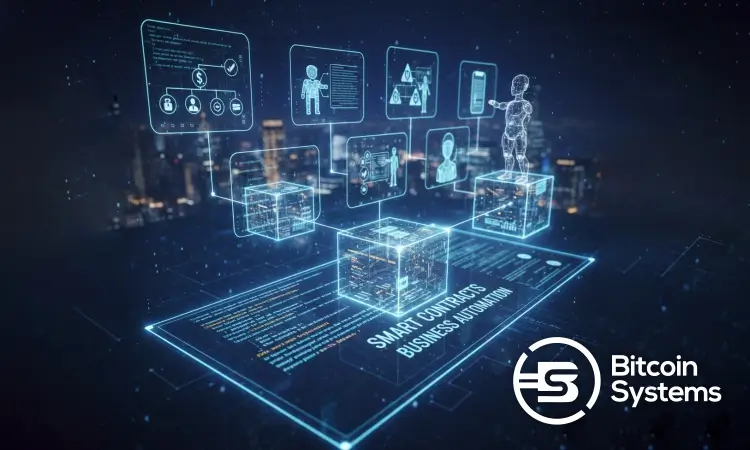
How Smart Contracts Are Redefining Business Automation
60views

Table of Contents
Smart contracts are proving to be the focal point of digitalization in business automation. Firms are forsaking the manual systems and adopting automatic agreements. Such contracts are blockchain based, fast, transparent, controlled, and involve fewer intermediaries.
Smarter Processes Through Autonomous Execution
Smart contracts are computer codes, which automatically execute functions when the requirements are fulfilled. They are not subject to approvals, signatures and third party control. This automation eradicates errors and ensures that there is accuracy and uniformity in agreements made.
Thus, every single step is recorded to the blockchain and the contract performance is made transparent and irreversible. The flow of transactions can be fully visible to the firms and this inculcates confidence in the operation and reduces occurring conflicts. Since the systems continue to get better, they help organizations to simplify the complex processes, yet make them controllable.
Artificial Intelligence Integration.
The combination of AI will make smart contracts not mere and simple automated tools but smart systems. This blend creates the prospects of smarter and more flexible business processes that can be adjusted to real world changes.
- Adequacy of Dynamic Contracts.
Smart contracts can be changed using AI according to real-time inputs such as weather, price, or delivery delays. This increases their application in uncertain business conditions.
- Predictive Decision-Making
AI is used to predict such events as equipment malfunction or demand spikes based on patterns. The preventive action can then be automatically carried out by smart contracts.
- Automated Learning
With time, AI can aid contracts in achieving more positive results based on what has occurred in the past. This will lead to smarter automation and improved performance.
- Complex Logic Handling
Artificial intelligence allows the contracts to take into account a variety of variables and make delicate decisions. It fits well in such fields as law, logistics, and healthcare.
- Enhanced Fraud Detection
AI is able to recognize abnormal behavior and issue warning indications in real time. This enhances contract integrity on high risk business markets such as finance and insurance.
Expanding Use Across Multiple Industries
Smart contracts have already changed areas in finance, real estate, healthcare and logistics.They computerize loans, payments, and settlement of insurance in the sphere of finance without delays or manual processing. They ease the ownership transfer and escrow service in real estate.
They are used in supply chains to monitor the deliveries, check the shipment, and pay the vendors automatically. Smart contracts are being used in healthcare systems to support the management of patient records and automated insurance claims. Such contracts ensure compliance and minimize mistakes when handling data in sensitive settings.
Even retail and education are considering the use cases, such as digital certification and loyalty programs. With the maturity of technology, additional industries are getting customized applications. It demonstrates that smart contracts in the real-world environment are becoming more flexible and scalable.
Benefits Driving Mass Adoption
The concept of smart contracts is on the rise in the scope of industries owing to its ability to provide viable solutions to traditional business deficiencies. The technology is making it more useful to enterprises because these advantages are accelerating the adoption.
Cost Reduction
The middlemen become unnecessary, and this eliminates the legal and administrative expenses related to smart contracts. This enables businesses to run lean and to use resources more productively.
Speed and Efficiency
Once the requirements have been met, the transactions are then made instantly without delay. This saves much processing time and it enhances efficiency of the overall workflow.
Transparency and Trust
Blockchain tracks all activities, and the terms of contracts and their execution are completely available to everyone. This fosters confidence and minimizes the possibility of conflict.
Security and Accuracy
Fraud and human error risk are minimized by means of encryption and automation. Contracts become more stable and less manipulable as a consequence.
Competitive Advantage
More secure and faster operations make businesses better than those with traditional competition. It enhances customer satisfaction by delivering services in a smooth manner.
The Future: smart contract 2.0.
The second generation of Smart Contracts 2.0 has taken a significant leap with such additional functions as cross chain communication and security. These new generation contracts enable businesses to run on several blockchains with ease. They also facilitate the association with legacy systems and external data sources.
They are more intelligent and cost effective due to layer-2 scaling and AI capabilities. They are adjusted to external events like market changes or legal changes. This builds smarter workflows, which eliminate delays and enhance compliance.
The companies are not simply automating with Smart Contracts 2.0, but they are constructing smart. These contracts can learn, predict and undertake with more flexibility. This is the reason why they are defining the Future of decentralized business operations.
Conclusion
Smart contracts are changing the process of business automation by providing speed, trust, and savings as they offer secure, self executable contracts. In combination with AI and interoperability, they open up additional potential in industries. The use of smart contracts will keep reshaping the operations of organizations in a digital first economy as technology evolves.
add a comment

The Role of Zero Knowledge Proofs in Securing Crypto Privacy
The blockchain security is a competitive advantage in the digital era that is constantly evolving, and it is also a...
